

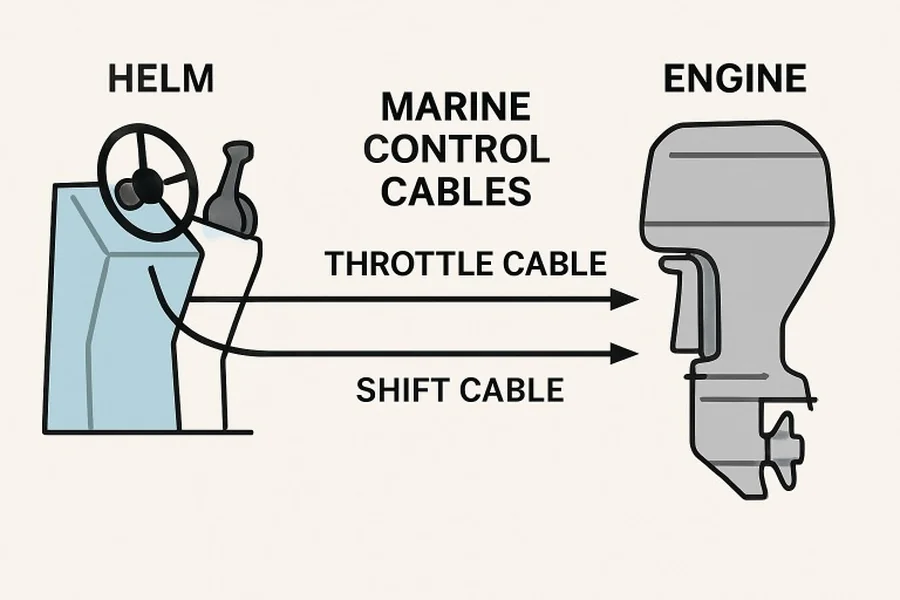
The efficient and safe operation of your boat begins with selecting the right marine engine control cables, a critical yet often overlooked detail during vessel setup or maintenance. These cables ensure that throttle and shift commands transfer smoothly from the helm to the engine, directly influencing your boat’s overall responsiveness and safety on the water. If you’re updating, maintaining, or troubleshooting your control system, don’t forget that marine plumbing parts and supplies are essential for keeping your entire engine and control system functioning optimally. Marine engine control cables are essential for durability in harsh marine conditions, providing smooth push-pull operation crucial for safety and preventing breakdowns. They must be compatible with various systems, including fuel lines and steering cables. Regular inspections and sourcing from reputable suppliers are recommended for optimal performance.
Understanding Marine Engine Control Cables
Marine engine control cables function as the vital link between your boat’s control levers and the propulsion systems. Unlike standard mechanical cables, marine-specific designs are constructed with high-tolerance components, ensuring they withstand the challenging marine environment—where moisture, vibration, and corrosion are constant threats. By maintaining a secure and reliable connection, these cables are essential for providing smooth acceleration, deceleration, and gear transitions, allowing you to have precise control over your vessel.
Types of Control Cables
Marine engine control cables come in a few primary types, each defined by its construction standards and intended application:
-
33 Series Cables: The most common standard, featuring a 10-32 threaded end connection and a 3-inch travel distance (throw). These cables are compatible with a wide range of throttle and shift control systems and are recognized in the industry for their reliability, ease of installation, and broad compatibility.
-
6400 Series Cables: Less common in newer models, these are typically found in older mechanical shift systems, marked by a thicker 5/16 thread and a longer 4-inch throw. They are primarily used for heavy-duty applications or specific transmission linkages.
Factors to Consider When Selecting Control Cables
Choosing the correct cable means looking beyond just the series number. There are several critical considerations:
-
Length: Measure the routing path from the helm to the engine, making sure to add a buffer for bends, turns, and potential future rerouting.
-
Compatibility: Double-check that the cable aligns with both your engine model and your control lever. Each system—whether it’s a dual-function control or a side-mount lever—may demand specific cable terminations or lengths.
-
Quality and Material: In saltwater environments, selecting cables made from high-grade stainless steel and featuring tough, corrosion-resistant jackets enhances durability and reliability.
Installation Tips
Proper installation prolongs cable life and ensures responsive, safe control. Keep these tips in mind for the best results:
-
Never force cables around tight corners; use gentle arcs to avoid internal friction and prevent kinking.
-
Position cables away from heat sources (like exhaust manifolds) and move engine parts to reduce wear and risk of damage.
-
Secure all connections using manufacturer-recommended clamps and retainers to avoid accidental slack or detachment.
Maintenance and Inspection
With even the best cables, regular maintenance is essential. Perform routine checks for cracked jackets, kinks, or areas of corrosion. Lubrication of cable ends, as specified by the manufacturer, can extend service life and maintain smooth operation. Replace cables at any sign of significant wear, as failures can lead to loss of control.
As a best practice, consult with your marine mechanic or refer to maintenance guides from reputable sources to help stay ahead of potential cable issues.
Advancements in Control Cable Technology
The marine industry continues to innovate, offering newer “premium” control cables boasting splined core designs and advanced synthetic jackets. These advancements reduce friction, increase longevity, and significantly improve the feel at the helm. Premium cables, although often more expensive, are an excellent investment for high-use or performance-critical applications, ensuring that controls remain light, accurate, and responsive even under heavy loads or challenging conditions.
Conclusion
Choosing the right marine engine control cables ensures your boat performs reliably and safely, whether you’re on a short cruise or an extended voyage. By understanding cable types, considering necessary factors for selection, and adhering to best practices for installation and maintenance, you can significantly reduce downtime and enjoy peace of mind on the water. Stay proactive about routine checks and invest in modern cable technology to experience the next level of boating confidence and control.
