

Hybrid cars have become an interesting option for Indian buyers who want lower fuel consumption without moving entirely to an electric vehicle. They combine an internal-combustion engine with an electric motor, making them particularly appealing for people who spend a lot of time in city traffic.
But buying a hybrid is not only about the showroom price. Once the car is parked at home, owners often start thinking about another expense: protecting that new-car finish.
So, when someone searches how much does hybrid car costs, should the budget also include PPF film protection?
The answer depends on how you use the car, but there are some practical points worth considering.
How Much Does a Hybrid Car Cost in India?
A hybrid’s price depends on the manufacturer, model, battery system, equipment level, and variant. Strong-hybrid models generally cost more than comparable petrol-only versions because of the additional electric drivetrain components and technology.
The purchase price is only the beginning, though. Insurance, registration, servicing, tyres and fuel all contribute to the total cost of ownership.
For someone researching how much a hybrid car costs, it makes sense to look beyond the ex-showroom figure and consider the expenses that follow during ownership.
One of those optional expenses can be exterior paint protection.
Why Protect a New Hybrid Car?
A new car often spends its first few months looking almost showroom-perfect. Unfortunately, Indian roads don’t always cooperate.
Loose stones, road debris, tight parking spaces, dust and careless contact can leave marks on painted panels. Bird droppings and tree sap can also become difficult to remove if they remain on the surface for too long.
Hybrid cars aren’t immune to these problems simply because their drivetrain is different.
In fact, someone who has paid a premium for a new vehicle may be more interested in preserving its appearance, especially if they intend to keep it for several years or sell it later.
What Does PPF Film Actually Do?
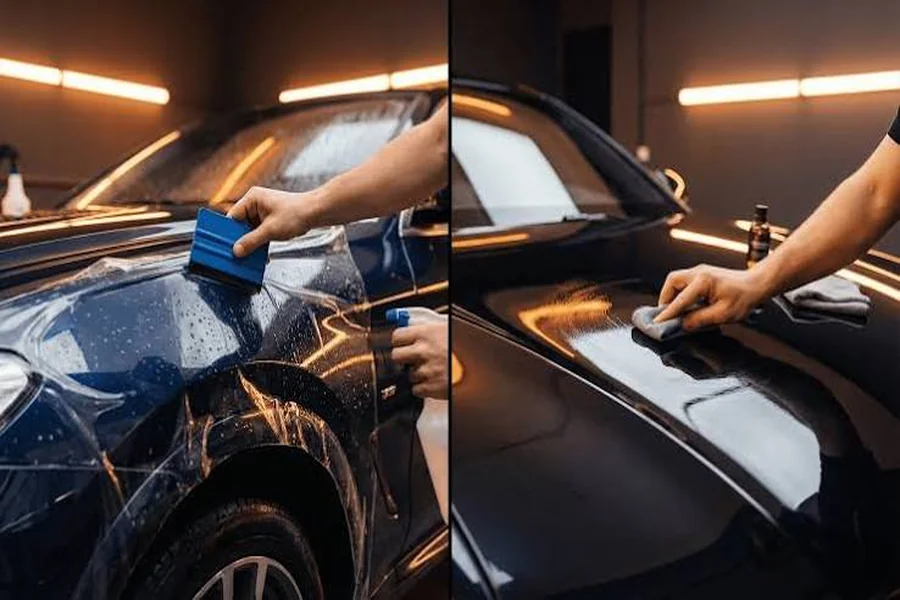
PPF film, or Paint Protection Film, is a transparent or finish-specific protective layer installed over painted body panels.
Its main advantage is that it provides a physical barrier. When small stones or road debris strike a protected panel, the film can absorb some of the impact instead of allowing it to reach the paint directly.
PPF is commonly installed on the front bumper, bonnet, front fenders, and ORVMs. Door edges and handles can also be protected because these areas are prone to small scratches during everyday use.
Some modern films feature self-healing top coats, which can reduce the appearance of fine surface marks under suitable heat.
Does Every Hybrid Need Full-Body PPF?
Not necessarily.
Full-body PPF provides the widest coverage, but it can also be a significant additional expense. For many owners, protecting the most vulnerable panels is a more sensible starting point.
A front-end package can cover the bumper, bonnet, and front fenders. If the car regularly travels on highways, broader coverage may be worth considering because those areas face greater exposure to road debris. The right coverage depends on the vehicle and its daily routine.
PPF and Ceramic Coating Are Not the Same
Some hybrid owners consider ceramic coating instead of PPF.
Ceramic coating can provide hydrophobic properties, improve gloss, and make routine cleaning easier. However, it isn’t designed to absorb stone impacts in the same way as a physical film.
If stone chips are the main concern, PPF is the more relevant product.
For owners who mainly want easier maintenance and a glossy appearance, ceramic coating may be enough. Some people also use both, applying PPF to high-impact areas and a compatible coating elsewhere.
Installation Quality Matters
Buying expensive PPF film is only part of the process.
The paint needs to be thoroughly cleaned and decontaminated before installation. Existing scratches or paint defects should be assessed beforehand because PPF won’t magically repair damaged paint underneath.
The installer also needs to handle panel edges, curves, and difficult sections carefully. Poorly finished edges can affect both appearance and durability.
A professional installation is therefore just as important as the film itself.
Think About Your Actual Driving Habits
The best way to decide whether PPF belongs in your hybrid budget is to look at how the car will be used.
Do you drive on highways every week? Is the car parked outdoors? Do you regularly travel through dusty or construction-heavy areas? Are you planning to keep the vehicle for five or more years?
The answers can help determine whether full coverage, partial protection, or no PPF is the most practical choice.
Conclusion
PPF film can be a useful addition for hybrid owners who want to preserve their vehicle’s original paint against stone chips, minor scratches, and everyday road wear. It isn’t essential for every car, and full-body coverage isn’t always necessary.
For a new hybrid that is expected to stay in the family for years, protecting the most exposed panels can be a practical middle ground. The goal isn’t to spend more simply because the car is expensive; it’s to spend where the protection genuinely makes sense.
